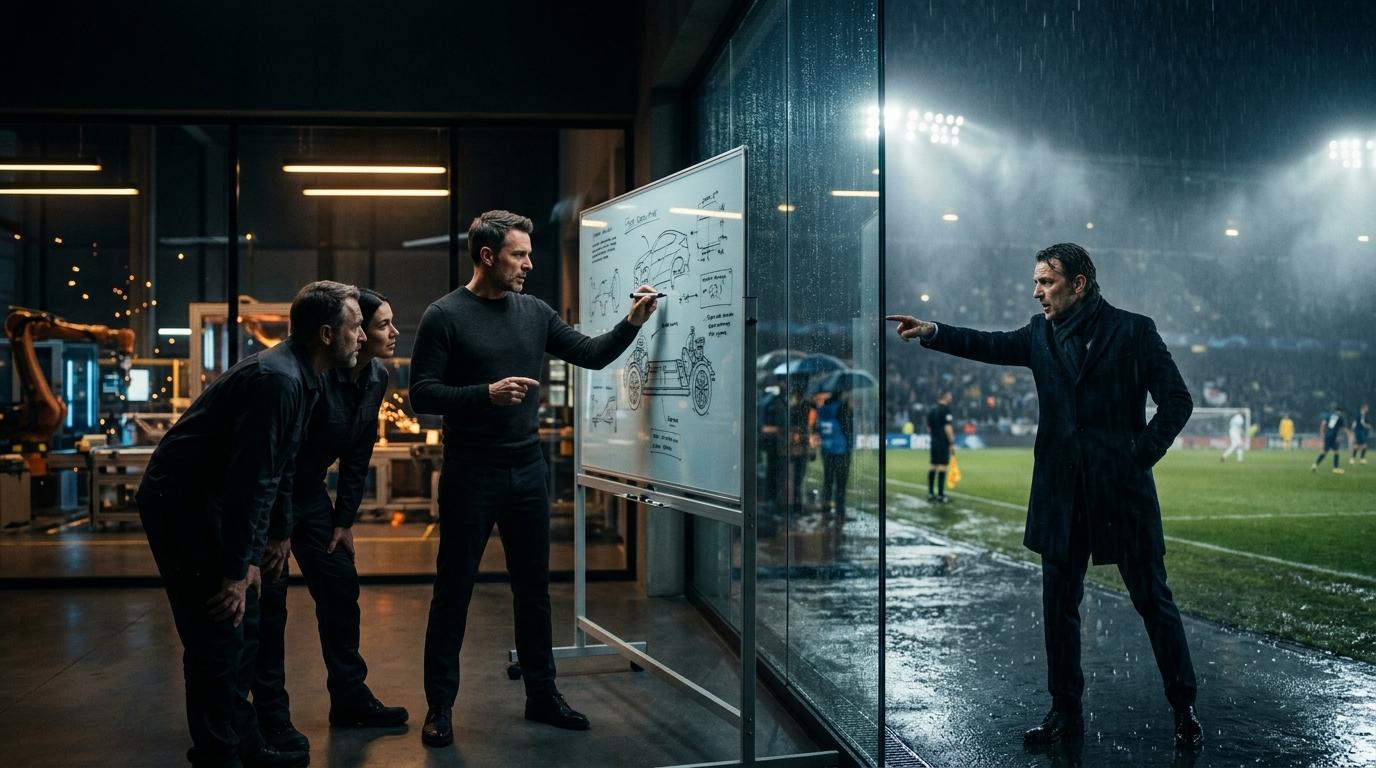
I see a completely different reality. In today's hyper-volatile business arena, retreating to the luxury box is the fastest way to lose the championship.
In European football (soccer), there is a famous saying: football is a manager's game. Unlike sports with scripted plays and constant timeouts, 90 minutes of football is an unbroken stream of real-time variables. The outcome of the match depends heavily on a manager standing on the touchline—thinking three moves ahead, reading tactical shifts on the pitch, and making decisive substitutions in the heat of the moment.
Business today operates under the exact same physics. In fact, a landmark 60-year empirical study by management scholars Donald C. Hambrick and Timothy J. Quigley in the Strategic Management Journal revealed that the "CEO Effect"—the proportion of variance in corporate performance directly attributable to the individual chief executive—nearly tripled from 6–8% in the 1950s to over 20% in the modern era.1
When variables compound in real time, a company's survival becomes profoundly dependent on a CEO who can read the field several moves ahead and make instantaneous tactical decisions.
A recent appearance by Jon McNeill—former President of Tesla and current CEO of DVx Ventures—on Shane Parrish's The Knowledge Project podcast pulls back the curtain on how Elon Musk played this exact game to scale Tesla 10x.2
I – Monday Meetings Without Slide Decks: Step Out of the VIP Box and Onto the Touchline
One Monday morning at Tesla, Elon Musk handed Jon McNeill a seemingly impossible mandate:
"The marketing budget is zero, and the company needs to double every six to eight months."[^2]
McNeill, who indeed helped scale Tesla roughly 10x during his tenure, recalls a pivotal Monday product meeting when Model X sales were sluggish and failing to hit their stride.2
Elon opened the meeting with a single question: "What does the market want?"
McNeill answered with raw ground truth: mothers needed to fit three child car seats side by side, which meant they wanted a second-row bench seat. At the time, the Model X only offered two independent captain's chairs in the second row.
In a traditional Fortune 500 corporation, what happens next? A task force is formed, market research is commissioned, and three weeks later, a 40-slide PowerPoint deck is presented to a committee to debate feasibility.
Instead, Elon stood up, walked straight to the whiteboard, and started sketching how to physically engineer a bench seat onto the existing Model X chassis.2
It wasn't an easy engineering problem. Yet look at the chain reaction that followed in that room:
The Head of Engineering walked up to the whiteboard and started sketching alongside him. The Head of Supply Chain stayed in his seat and immediately began sourcing parts and checking vendor lead times in real time. There was zero debate over the obvious, and zero presentation slides. They went straight into execution.
Junior engineers sitting in the back of the room watched this unfold and absorbed a permanent cultural lesson: "Around here, you don't get rewarded for preparing slides—you get rewarded for finishing the job."2
A great football manager doesn't sit in the VIP suite waiting for post-match analytics. They stand in the rain on the touchline, redrawing the tactical board the exact second a gap appears.
This is the beating heart of what Paul Graham and Airbnb's Brian Chesky call "Founder Mode."3 Treating departments as opaque black boxes ("Manager Mode") fails when the market shifts by the hour. When the CEO steps up to the whiteboard and breaks the bottleneck on the spot, the entire organization synchronizes at the speed of the leader.
II – Dominate Every Dimension of Velocity: Why Slow Decisions Are Silent Suicide
According to McNeill, Elon Musk's operating system boils down to a relentless obsession with velocity.
Elon believed that to win, Tesla had to outpace competitors across every conceivable dimension of speed: decision velocity, cash velocity (how fast capital circulates through the company), and response velocity.2
Why? Because in any industry, your competitors are almost certainly bogged down by bureaucracy.
Extensive research by McKinsey & Company on executive decision-making proves that this obsession with speed is backed by hard financial math:
The Winner's Multiplier: Organizations that excel at both decision speed and quality ("Decision Winners") are twice as likely to achieve financial returns of 20% or more from their strategic decisions compared to slower peers.4 Shattering the Speed-vs-Quality Myth: Leaders often delay choices in the name of "thoroughness." Yet McKinsey data shows that fast decision-makers are 1.98 times more likely to make high-quality decisions than slow ones, because rapid execution triggers real-time feedback loops instead of analysis paralysis.4 The Staggering Cost of Latency: In a typical Fortune 500 company, sluggish decision-making wastes more than 530,000 manager days per year—roughly $250 million in lost annual wages spent on bureaucratic friction.4
flowchart TD
    subgraph ManagerMode ["🐢 Spectator Manager Mode (Traditional Corp)"]
        A1["Field Variable Emerges<br>(Model X Seating / Falcon Door Issue)"] --> A2["Staff Drafts Reports &<br>Slide Decks (2–4 Weeks)"]
        A2 --> A3["Multi-Layer Committee Debates<br>(Blame Avoidance & Analysis Paralysis)"]
        A3 --> A4["Missed Market Window &<br>530,000 Manager Days Wasted Yearly"]
    end

    subgraph FounderMode ["⚡ Touchline Manager Mode (Elon Musk & Jon McNeill)"]
        B1["Real-Time Variable & Bad News Escalated<br>('Bring Bad News Immediately')"] --> B2["CEO's Direct Tactical Intervention<br>(Whiteboard Sketching / 2-Hr Line Walk)"]
        B2 --> B3["Simultaneous C-Suite Execution<br>(Engineering + Supply Chain Act in Room)"]
        B3 --> B4["Custom Jig Built That Same Night<br>→ Company Doubles Every 6–8 Months"]
    end
To keep decision latency near zero, Elon enforced one unbreakable rule across Tesla:
"Bring bad news as soon as you know it. Bad news does not get better with age."[^2]
If a star defender pulls a hamstring in the 20th minute of a match, and the assistant coach hides it from the manager out of fear, the team will get destroyed on the counter-attack. At Tesla, hiding bad news was the fastest way to lose Elon's trust.2
Consider what happened on the very first day McNeill met Elon. The Model X's Complex Falcon Wing doors had been plagued by assembly issues that had gone unsolved for weeks. Instead of sitting in an office, Elon and McNeill walked the production line together for two hours. Observing the bottleneck firsthand, McNeill suggested building a custom fixture (a jig) to align the doors. Elon immediately replied, "Let's try it." They built the jig that very night.2
A multi-week manufacturing stalemate was broken in a single evening because the CEO was on the pitch, ready to greenlight a tactical experiment on the spot.
III – "Find the Answer, Then Hit the Speed Button": The Art of Tactical Pacing
At this point, a critical question arises. If a CEO pushes the organization at breakneck velocity every single day, doesn't everyone—including the CEO—inevitably burn out?
When asked about burnout, McNeill delivered a masterclass in operational pacing:
"You don't sprint at full speed every single moment. First, you figure out how to solve the problem—and once you find the answer, that's when you hit the speed button."[^2]
Read that sentence again. It captures the exact essence of why modern business is a tactical manager's game.
An amateur football manager screams at their players to run at full sprint for 90 minutes. By the 60th minute, the players are cramping, exhausted, and structurally exposed.
A master tactician operates differently. First, they probe, diagnose, and figure out the geometry of the problem (How do we fit a bench seat? Why is the Falcon Wing door misaligned?). They don't waste energy sprinting blindly in the wrong direction. But the millisecond the tactical solution is unlocked, they hit the speed button—mobilizing engineering, supply chain, and capital in an all-out blitz.
Luxury-Box Administrator vs. Touchline Tactical CEO
| Dimension | 🔴 Luxury-Box Administrator (Manager Mode) | 🟢 Touchline Tactical CEO (Founder Mode) |
|---|---|---|
| Meeting Culture | Polished PowerPoint decks and rehearsed updates | No slide decks; real-time problem solving on the whiteboard2 |
| Bad News Protocol | Filtered and delayed by middle management | "Bring bad news immediately" (zero information latency)2 |
| Field Presence | Manages via quarterly KPIs from behind the org chart3 | Walks the production line for 2 hours; builds the jig that night2 |
| Energy Pacing | Chronic bureaucratic exhaustion without breakthroughs4 | Diagnose first → Hit the "Speed Button" once solved2 |
| Growth Outcome | Reverts to industry-average growth | Doubles every 6–8 months (10x scale with $0 marketing)2 |
This is why companies today are more dependent on their CEO's cognitive agility than ever before:
-
Diagnostic Precision: Spotting the true bottleneck—whether it's three car seats for mothers or a missing assembly jig—requires a leader who refuses to be insulated by layers of abstraction.
-
Real-Time Orchestration: Only the chief decision-maker has the authority to stand at a whiteboard and compress months of cross-departmental friction (Engineering + Supply Chain) into a single 30-minute room session.
-
Tactical Pacing (The Speed Button): Knowing when to pause and diagnose versus when to press the accelerator to the floor is the ultimate strategic differentiator between sustainable hyper-growth and organizational burnout.
💭 Questions to Reflect On After Reading
-
In your organization or business, how many hours (or weeks) of latency exist between a "bad news" variable occurring on the front line and the final decision-maker acting on it?
-
Are your meetings designed around polished slide decks that mask problems, or whiteboards where engineering and operations solve the bottleneck in the room?
-
Looking at your current projects, which problem still requires patient diagnosis on the pitch, and which one has already been solved and is waiting for you to hit the speed button?
Share your thoughts in the comments below.
Conclusion: Where Are You Standing on the Pitch?
In a slow, predictable world, a company could run on autopilot with a playbook written five years ago.
But in an era where technological shifts and market variables erupt in real time, business has become the ultimate touchline sport. Elon Musk couldn't have scaled Tesla 10x by being fast alone; he scaled it because his personal decision velocity set the metabolic rate for every executive and junior engineer in the building.2
Just as 90 minutes of football is defined by the manager's tactical mind, modern business rises and falls on the CEO's ability to see three moves ahead, demand bad news immediately, sketch the solution on the whiteboard, and hit the speed button at the exact right moment.
"As real-time variables reshape your industry every week, are you sitting in the luxury box waiting for a slide deck—or are you standing on the touchline with a whiteboard marker in hand?"
Sources
If you found this valuable, share it with one founder, leader, or teammate who loves building at high velocity.
Footnotes
-
Quigley, T. J., & Hambrick, D. C. (2015), "Has the 'CEO effect' increased in recent decades? A new explanation for the great rise in America's attention to corporate leaders," Strategic Management Journal, 36(6), 821–830. https://doi.org/10.1002/smj.2230 ↩
-
Shane Parrish (Farnam Street), "Jon McNeill (Former President of Tesla & CEO of DVx Ventures) on Scaling Tesla 10x, Elon Musk's Speed Principles, and Execution Culture," The Knowledge Project Podcast, 2026. https://fs.blog/knowledge-project-podcast/ ↩ ↩2 ↩3 ↩4 ↩5 ↩6 ↩7 ↩8 ↩9 ↩10 ↩11 ↩12 ↩13
-
Paul Graham, "Founder Mode (Inspired by Brian Chesky's YC Talk on Direct Tactical Leadership vs. Modular Delegation)," paulgraham.com, 2024. https://paulgraham.com/foundermode.html ↩ ↩2
-
McKinsey & Company, "Decision making in the age of urgency / Untangling your organization's decision making," McKinsey Quarterly. https://www.mckinsey.com/capabilities/people-and-organizational-performance/our-insights/decision-making-in-the-age-of-urgency ↩ ↩2 ↩3 ↩4